
Activated Insights just released its 2026 Benchmarking Report, one of the largest studies of its kind in home-based care, drawing on responses from over 1,000 agencies nationwide. The report is organized around six themes shaping the industry this year: satisfaction, turnover, measurement, training, revenue and margin, and technology.
All six are worth knowing, but two of them connect directly to the tools you already rely on in Rosemark for scheduling, caregiver management, and client care, so that’s where we’ll spend most of our time: what happens when you listen to clients and caregivers consistently, and what happens when training goes beyond checking a compliance box. Here’s what the data shows on those two, plus a quick look at the other four. 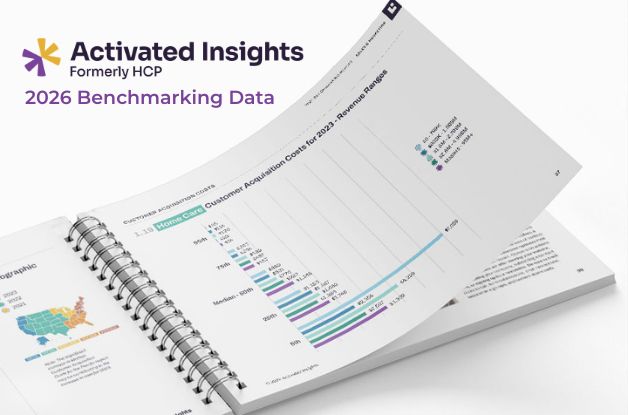
Listening and measuring consistently pays off
Care professional satisfaction and client satisfaction both hit record highs this year, continuing four straight years of improvement. Client turnover kept falling too, extending an eight-year decline. Word-of-mouth referrals remain the single biggest source of new business, ahead of every paid channel the report tracks. The pattern behind that: agencies that consistently ask clients and caregivers how things are going, act on what they hear, and then remeasure to see if it actually moved the needle, build the kind of reputation that turns into referrals and steadier retention over time. It’s a feedback loop, not a one-time survey: listen, act, remeasure, repeat, and over time that’s what makes an agency the kind people actively want to recommend and want to work for.
There’s a second, related pattern in the report worth separating out. Agencies that track every client inquiry, where it came from, whether it converted, where it dropped off, post median revenue of $3.15M, more than double the $1.40M reported by agencies that don’t. That gap has widened for five straight years. This isn’t about reputation; it’s about visibility into your own funnel. Agencies that measure their conversion process know which referral sources and marketing channels are actually worth their time, and which aren’t.
Together, these two habits cover both ends of growth: reputation that generates inbound interest, and measurement that makes sure you’re converting it. That’s exactly where Experience Management, from Activated Insights, fits into your Rosemark workflow. It turns routine client and caregiver feedback collection into the consistent “listen-act-measure again” loop the data links to stronger referrals and retention, using the scheduling and client data you’re already tracking in Rosemark.
Caregivers rate their training highly. Administrators aren’t so sure it’s working.
This is one of the more telling findings in the whole report. Caregivers rated the training they received at 9.11, near the top of the entire employee experience survey, in an industry where holding onto good people is one of the hardest operational challenges an agency faces.
So why are nearly 6 in 10 administrators uncertain that training is actually building the skills caregivers need in the field? The data points to a gap between compliance and competency: most administrators are confident their training meets state requirements, but far less feel the same about real-world skill development. That disconnect shows up downstream, in client complaints, in caregiver uncertainty on the job, and in turnover. Nearly half of agencies also report that replacing departing staff now eats up 40% or more of their total training effort, leaving less room to actually develop the caregivers who stay.
The agencies closing this gap are moving past check-the-box training toward programs built for real skill-building, ones that hold up for both the caregiver in the field and the auditor. That’s the thinking behind Rosemark’s integration with Activated Insights Training: it connects directly with the scheduling and compliance tracking you’re already doing in Rosemark, so training records and caregiver data stay in sync without extra manual work on your end.
Rounding out the six themes
Caregiver turnover has plateaued after peaking in 2023, but it hasn’t disappeared as a challenge, and the data shows a few clear levers agencies can still pull. Wages are the most measurable one: agencies in the lower pay bands report significantly higher turnover than agencies just a couple dollars an hour higher. Pay structure matters too. Daily pay, weekly pay, and flexible scheduling ranked alongside base wage among the benefits most associated with retention, meaning flexibility in how caregivers are paid carries about as much weight as how much they’re paid.
On the revenue side, median revenue grew double digits industry-wide this year, continuing a multi-year climb. But growth is coming with more cost pressure attached: client acquisition costs rose for the third straight year, and a shifting payer mix is adding complexity to the margin equation. The agencies managing this well are the ones tracking their funnel closely enough to know which dollar of revenue is actually worth chasing.
And on the technology side, automation is now the industry’s top cost-reduction strategy, ahead of both cutting overtime and changing pricing models. Office staff headcount is trending down across agency sizes even as revenue holds steady or grows, which suggests agencies are finding real efficiency gains rather than just doing more with the same headcount. Notably, these gains aren’t reserved for the largest agencies. More than half the industry has now standardized on a single scheduling platform, and the tools driving efficiency at top performers are available at every size.
The takeaway for Rosemark agencies
Two threads run through this year’s report that Rosemark users are especially well-positioned to act on: listening to clients and caregivers consistently, and training that goes beyond compliance. Both are areas where Rosemark’s integrations with Activated Insights, Experience Management for client and caregiver surveys and Training for caregiver development, connect directly to the scheduling and operations data you already manage day to day. The agencies pulling ahead aren’t necessarily the biggest ones. They’re the ones building consistent habits around measurement, feedback and skill-building, then letting the data guide what comes next.
Want to go deeper? Watch the on-demand recording of our webinar, 6 Key Findings from the 2026 Benchmarking Report, where our CMO and VP of Data and Analytics walk through all six themes and what they mean for your agency.